Survey Guide: Ghost-Kananaskis Sub-regional Plan Engagement
May 26, 2026
Ghost-Kananaskis Sub-Regional Plan Survey
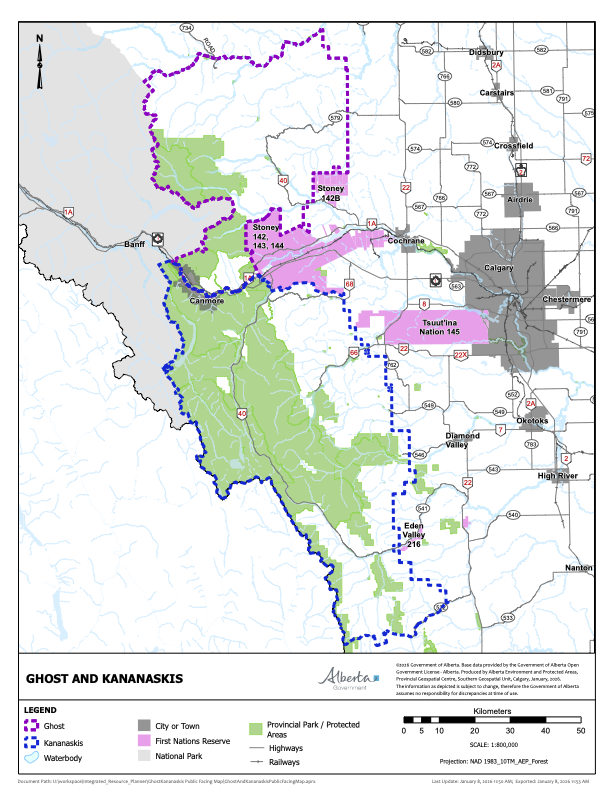
The Government of Alberta is currently accepting input for landscape level planning in the Kananaskis and Ghost regions. This plan will be in effect for at least 10 years and will guide how land management decisions are made.
There will be two phases to the consultation process.
Currently, Phase 1 is open, and provides the opportunity to guide the vision and outcomes of the plan. Feedback can be provided through an online survey, or by email (ghost-kananaskis-srp@gov.ab.ca) until June 5th, 2026.
The second phase of engagement is anticipated to be in winter 2026 and will involve the opportunity to provide feedback on a draft version of the plan.
We cannot overstate how important this region is for wildlife and biodiversity, for the tourism and recreation industry, as well as for our headwaters. What goes into this plan matters for all Albertans.
Survey Guide
As always, we recommend personalizing your feedback as much as possible. To help guide responses, our recommendations for the survey are available below.
Vision Statement
We recommend changes to the draft vision statement to reflect that the protection of the natural environment must be the region’s primary priority, as it underpins the long-term viability of the region’s communities and economies, and to explicitly include Indigenous peoples.
Recommendation: Select “I’m somewhat unsupportive of the vision statement”.
Can you explain why you’re somewhat unsupportive of the vision statement, and what could be improved to increase your level of support?
Recommendation: I recommend the following updated vision statement:
“The Ghost-Kananaskis Sub-regional Plan seeks to protect headwaters, preserve biodiversity, and support responsible low-impact land use that reflects the interests and values of local communities and the public good, while ensuring ecological integrity. As a region of critical importance for water security, landscapes will be managed with headwaters protection and biodiversity conservation as the primary objectives. Through active partnership with Indigenous Peoples, local residents and land users, and stakeholders, management will ensure that the Kananaskis and Ghost regions remain wild, beautiful, resilient, and accessible for generations to come.”
The vision statement should clearly commit to headwaters protection and biodiversity conservation as the primary objectives of the plan and make explicit that any land use must be responsible, low-impact, and consistent with maintaining ecological integrity.
Draft Outcomes
Select agreement level with each of the draft list of outcomes.
Are there any suggestions you have to improve the draft outcome list?
Recommendation: Choose Yes to reveal the next question.
What considerations do you feel are missing?
Recommendation: Headwaters protection and the conservation of biodiversity and water quality should be the overarching outcomes and primary priorities. These values are the foundation of the long-term viability of the region’s communities and economies and consistent with the overarching South Saskatchewan Regional Plan. Therefore, other outcomes should fall within these overarching priorities. Commitments to new and expanded protected areas to help achieve these goals should be included as outcomes.
The recreation and tourism outcome should establish outdoor recreation and tourism as priority long-term land uses, provided they are low-impact and ecologically sustainable. Local communities and stakeholders should be recognized as the key partners for this outcome.
The human footprint outcome should be strengthened by explicitly including the need for cumulative effects management with ecologically determined limits on human footprint that have clear and enforceable management mechanisms. As population and overall human footprint continues to increase in the region, this approach is essential.
The traditional land uses outcome should include recognition of the need for Indigenous involvement in decision-making and stewardship of the land, including through Indigenous-led conservation initiatives.
The natural resource economy outcome should clarify that resource extraction industries should only operate in a way that is consistent with overarching outcomes of headwaters protection and conservation of biodiversity and water quality.An outcome for climate change mitigation is missing. Climate-driven shifts in temperature and precipitation are already altering mountain hydrology and disturbance regimes, with well-established implications for headwaters regions: earlier snowmelt and earlier peak flows, reduced summer and late-season flows, increased year-to-year variability, and heightened risk of extreme events. Given the vital importance of the headwater regions, climate change resilience should be an outcome of the plan.
Please pick at least two outcomes that are most important to you.
Recommendation: Select “Our headwaters are protected” and “Human footprint is effectively managed to conserve biodiversity and water quality”.
Visitation and Use
This section provides a mapping tool where “pins” can be dropped on to the map to indicate where and why you choose to visit the area.
Recommendation: Prioritize the available low-impact options such as “Remote wilderness experiences”, “physical activities (non-motorized)”, “quiet relaxation and restoration”.
Conclusion
Do you have anything else to share about this topic?
Recommendation: Much of the headwaters of the Bow, Elbow, Ghost, and Highwood Rivers lie within this subregion. These watersheds are critically important to water supply and water quality for communities, agriculture, and industry. Protecting headwaters must therefore be the foundation and highest priority of this plan. Watershed health and ecological integrity should clearly be defined as the plan’s overarching priorities, with other low-impact land uses managed within ecologically sustainable limits.
More News
Silvertip Gondola All-Season Resort Area Designation Undermines the Future of Provincial Parks
This decision removes protected land from Bow Valley Wildland Provincial Park, allowing private development in an essential area for wildlife…
No Net Loss? The Questionable Logic for Destroying Critical Habitat in the Highwood and Loomis Creek
How ‘offsetting’ is being irresponsibly used to justify the destruction of critical habitat.…
New protected area in the grasslands of Southern Alberta a cause for celebration
The government has proposed a new protected area and, what’s more, it’s in the grasslands! …