
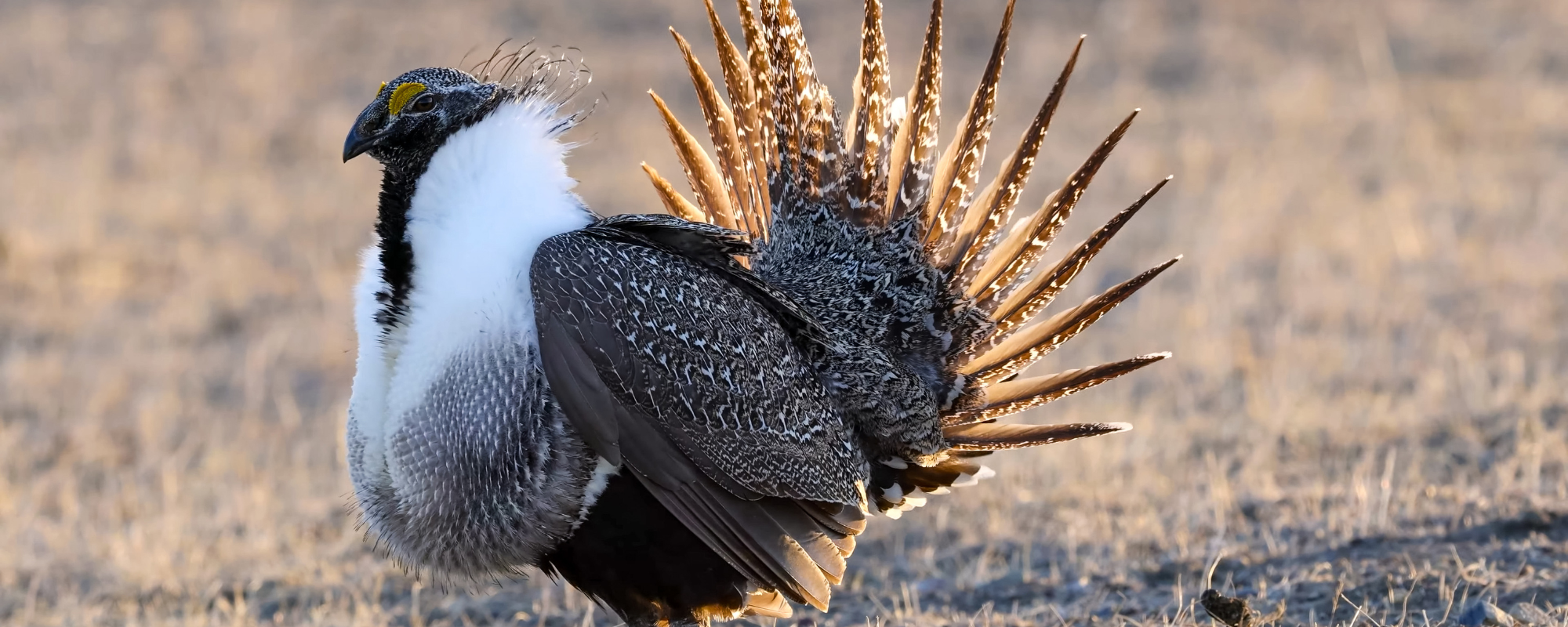
Government of Alberta quietly lifts restrictions protecting endangered Greater Sage-Grouse
Calgary | Mohkinstsis
October 15, 2026
The Government of Alberta has removed provincial habitat protections for the endangered Greater Sage-Grouse without any public consultation or official announcement.
The Greater Sage-Grouse (Centrocercus urophasianus urophasianus) occupies silver sagebrush grassland in southeastern Alberta. The species is listed as Endangered under the Species at Risk Act (SARA) and under the Alberta Wildlife Act because their population has declined precipitously.
The severity of their status is such that in 2014, a federal Emergency Protection Order came into effect to address imminent threats to their survival and recovery (i.e., to prevent extinction) in Canada.
Greater Sage-Grouse used to number in the thousands in Alberta as recently as the 1960s, but today their population is fewer than 100 individuals. The most recent publicly available census in 2023, conducted by the Government of Alberta, estimated there were as few as 54 individuals.
Their distinctive habitat requirements and sensitivity to human disturbance make them extremely vulnerable to both habitat degradation and noise, and their current distribution is less than 10% of their historical range due to habitat loss and fragmentation.
Reclamation work to restore habitat has been extensive. Enormous amounts of time and resources have been invested by government, non-profits, and landowners to improve their habitat. This work was expected to increase the grouse’s survival and reproduction success. However, the decision to remove habitat protections on ~2,800 km2 of land — roughly 74% of the total 3,800 km2 previously protected — puts all this work at risk of failure and is a staggering blow.
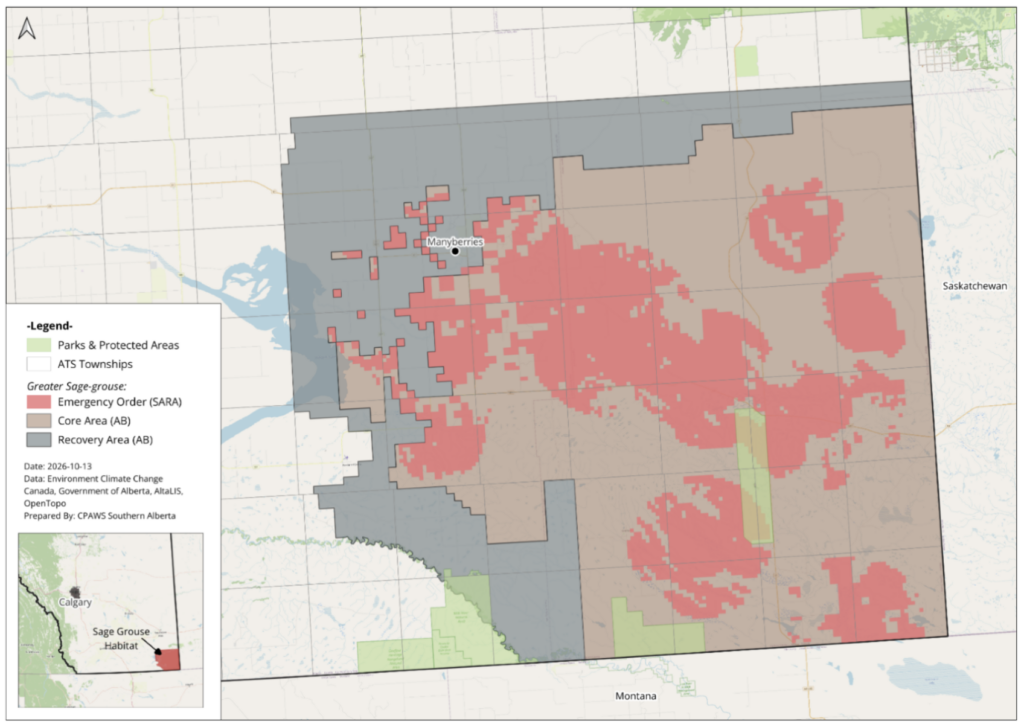
The already extremely small population size of Greater Sage-Grouse means that this loss of habitat protection puts them at imminent risk of extirpation. As Dr. Mark Boyce, Professor of Biological Sciences at the University of Alberta says, “Without these habitat protections we will lose Greater Sage-Grouse from Canada.”
Projects that would otherwise not be allowed — or which would have had strict restrictions — within provincial core and recovery habitats for Greater Sage-Grouse can now move forward.
Already, the Alberta Energy Regulator has approved the “construction of a small plant site” by a helium extraction company, Thor Resources. This is taking place in what was a provincially identified recovery area for the Greater Sage-Grouse, and without the habitat protections that would have been required.
Future helium development would require new well-sites, new processing facilities, new vertical structures, and new roads — infrastructure that was previously limited by the provincial habitat protections and that is known to have severe impacts on Greater Sage-Grouse.
The population has only hung on by a thread for two decades largely due to habitat protections that restrict industrial developments and a series of concerted conservation interventions. Over the past two decades, these conservation interventions have included five translocations from Montana populations, a captive breeding and release program, well-site reclamation at hundreds of well sites, predator control, and the establishment of many conservation easements on private land.
However, these types of interventions rely on the availability of undisturbed habitats that can support Greater Sage-Grouse.
“We are deeply disappointed by the Government of Alberta’s dismantling of habitat protection for the Greater Sage-Grouse. This unique bird is an icon of Alberta’s grasslands and, with fewer than 100 individuals remaining in our province, this irresponsible decision puts the species at great risk of extirpation,” concludes Josh Killeen, Conservation Science and Program Manager at CPAWS Southern Alberta.
For more information, click here to review our full briefing note, or please contact:
Josh Killeen
Conservation Science and Program Manager, CPAWS Southern Alberta
More News
Government of Alberta quietly lifts restrictions protecting endangered Greater Sage-Grouse
Provincial habitat protections for the endangered Greater Sage-Grouse have been removed…
Implementation Pathways for Sustainable Tourism in Alberta
Tourism proposals should consider cumulative effects, wildlife movement, species at risk, human-wildlife coexistence, and impacts throughout the entire project lifecycle.…
Six Guiding Principles for Sustainable Tourism in Alberta
Not every landscape can accommodate the same level of use — nor an ever-increasing level of use…