
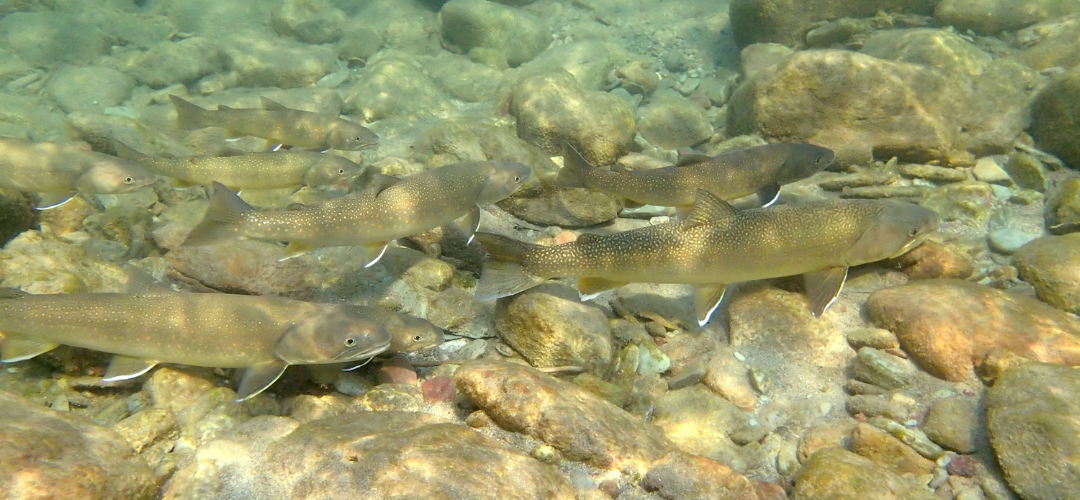
More Logging Mayhem for Oldman River Bull Trout
A Guest Post from Lorne Fitch
If you compare a map of the historic distribution of our native trout to their present status you’ll see there’s been a drastic reduction to the places they now occupy. You might think these are the best of the best remaining habitats, or maybe the last of the best.
In reality it is a retreat, under constant land use pressures, to the last of the last habitat. Native trout have been pushed to those places where their backs are against a wall. There is nowhere else left for them to go to escape the impacts of our relentless land use footprints—erosion, sediment, higher water temperatures, loss of watershed connections, and loss of complex habitat features. As habitat goes, so do the fish. Today, every native trout species in Alberta is at some level of immediate peril.
What’s left of their habitat, the last of it, is essential to their survival. Channeling George Orwell, all the remaining trout habitat is essential, but some is more essential than others. This is especially so for bull trout, recognized as our provincial fish, but afforded little else in keeping it swimming in Alberta.
Bull trout are consummate wanderers throughout watersheds. This creates migratory patterns in their search for food, overwintering spots, and places to spawn. In the Oldman River bull trout move upstream into the headwaters of the river and its tributaries to their birthplaces, to spawn and sustain the population.
The places they home to every fall have unique qualities, recognized by bull trout over millennia as essential features to successfully carry out their life cycle requirements. Intact and old forests are superb sponges—capturing, storing, and slowly releasing water that is cold, clean, and continuous in flow. The gravels, into which a female trout will excavate a depression to cast her eggs, are loose and free of sediment. Groundwater, a gift from the forest, bubbles up through the nest called a redd, to let the eggs breathe and to remove the metabolic wastes. There the eggs incubate until the spring.
If ever that were so, protecting these unique and irreplaceable spawning areas, an essential hub for sustaining bull trout over the entire watershed. But it seems we cannot offer bull trout even the most minimal of habitat assurances.
The epicentre for bull trout spawning in the Oldman headwaters is, or was, Hidden Creek, a small tributary that flows eastward from the Continental Divide. Fisheries biologists documented that about 75 per cent of the bull trout in the Oldman watershed homed to Hidden Creek every fall. If ever there was a situation where trout should have trumped logging, this was the place.
In the 1980s the Forestry Division decided the old growth spruce in the headwaters of Hidden Creek were in danger of wildfire, so a Crowsnest Pass logger was given permission to remove these immense (and very valuable) spruce. The lee side of the Continental Divide is wet and researchers pointed out the risk of wildfire there was miniscule. The age of the spruce, over 350 years old, confirmed this.
Covetous eyes of the timber industry turned to the pine and spruce of the lower portion the valley early in the 2000s. The first clear-cuts, on a small tributary of the stream, were located downstream of most of the spawning activity. Once started, with a bridge over the Oldman River and a road network in place, the pressure to log more of the Hidden Creek watershed escalated.
By this time enough spawning surveys had been done to confirm the importance and priority of the stream and its watershed to maintaining bull trout populations in the larger Oldman system. The Forestry Division equivocated on permission to log more of Hidden Creek, inevitably ignoring the concerns of provincial fisheries biologists, and finally acquiesced to the lobbying efforts of Spray Lakes Sawmills, out of Cochrane.
Logging proceeded over the winter of 2012/13. The guidelines for logging were bent to accommodate the logger, as we now know happens routinely, even when it affects Threatened trout species. Critical stream buffers were ignored to reduce the costs of road building. Logging was only to happen under frozen ground conditions to reduce soil disturbance and subsequent erosion, but with no government oversight this was largely ignored during chinooks. Erosion and sediment controls at tributary stream crossings were either non-existent or so poorly constructed that sediment poured around, over, or underneath them. At one crossing the sediment fence was still in a roll, propped up against a stump.
To compound the problems for bull trout there was an extreme weather event in the spring of 2013 that unleashed an atmospheric river of rainfall. Clear-cuts exacerbated the flood. To compound the problem, runoff from an August 2013
rain storm turned Hidden Creek into a muddy soup. Other streams in the area, subject to the same weather event, remained clear indicating that logging had substantially increased the erosion potential in Hidden Creek.
The combination dealt bull trout an almost mortal blow.
Following 2013 there was an 80 per cent reduction in bull trout spawning activity , measured by fewer redds. In one year there was only one redd, signalling only a pair of trout gambled on spawning success. A dozen years out, bull trout spawning activity has not reached pre-logging levels. It shows the effects of logging can linger and a landscape can hum like an anvil long after the hammer of development has hit.
The 2012/13 logging debacle of Hidden Creek is a cautionary tale of failures of responsible agencies and of the timber industry. If the Hidden Creek saga teaches us anything, it is cold, road-free, and intact watersheds are the hinge upon which the survival of native trout swing.
And yet, here we are again with plans for more logging, another bridge across the Oldman River, and more logging roads and clear-cuts in the Hidden Creek basin. The new bridge site is immediately upstream from a bull trout spawning area in the Oldman River. It may be that some bull trout have moved from Hidden Creek due to the impacts logging has brought to spawning potential there.
Department of Fisheries and Oceans, is the federal agency with legislative responsibilities under the Fisheries Act and the Species at Risk Act to protect bull trout. Perversely, DFO have provided West Fraser Cochrane a permit to destroy critical habitat in the Oldman River to accommodate their bridge crossing. This has likely been facilitated by the extensive lobbying effort of the timber industry to remove impediments to logging. DFO may well be the worse friend a fish ever had.
Proceeding to destroy critical habitat, already in short supply, shows a chronic inability to acknowledge, learn from mistakes, and not repeat them. Destroying critical habitat is akin to breaking an egg— making it functional again has huge challenges.
There are recurring problems with logging up and down the Eastern Slopes affecting species at risk trout, especially the chronic inability of industry to follow even the
most minimal of logging guidelines. Self-regulation by industry and rigorous regulatory oversight by provincial and federal officials are fever dreams.
Meanwhile the last of the last of bull trout habitat will suffer further losses, the population of this Threatened species in the Oldman watershed will diminish, and soon there will be no impediments to our rapacious land-use desires.
The aquatic indicators of our stewardship ethic will continue to disappear—one bridge, one clear-cut, one logging road, and one federal permit at a time.
Lorne Fitch is a Professional Biologist, a retired Fish and Wildlife Biologist and a former Adjunct Professor with the University of Calgary. He is the author of Streams of Consequence, Travels Up the Creek, and Conservation Confidential.
More News
Six Guiding Principles for Sustainable Tourism in Alberta
Not every landscape can accommodate the same level of use — nor an ever-increasing level of use…
Silvertip Gondola All-Season Resort Area Designation Undermines the Future of Provincial Parks
This decision removes protected land from Bow Valley Wildland Provincial Park, allowing private development in an essential area for wildlife…
No Net Loss? The Questionable Logic for Destroying Critical Habitat in the Highwood and Loomis Creek
How ‘offsetting’ is being irresponsibly used to justify the destruction of critical habitat.…