
Can there be too many people on the land?
Mohkinstsis/Calgary, Alberta
August 31, 2026
Emma Hoskins, CPAWS Southern Alberta Conservation Campaign Specialist
It’s no secret that Albertans love the outdoors. In fact, and according to the 2022 Alberta Recreation Survey, 86% of Albertans participate in outdoor recreation, and both land-based and water-based recreation have increased by about 5% and 10% respectively since 2017.
And we’re not the only ones enjoying the province’s awe-inspiring landscapes; some of Alberta’s most popular destinations are experiencing record visitation. In 2025, Banff National Park welcomed over four million visitors, while Kananaskis Country saw more than five million.
In so many ways, we’re delighted that more people are opting to spend time in nature! That’s good news. Spending time outside has been proven to benefit people’s physical and mental health and, as more folks get outside, more will be inspired to protect it.
At the same time, we also need to recognize that not every landscape can accommodate the same level of use — nor an ever-increasing level of use. Landscapes, and ecosystems, have ‘carrying capacities.’ These aren’t infinite.
As the Government of Alberta pursues tourism growth in our province, this reality needs to be faced, and conversations need to be had about how we’re managing that growth. The provincial government’s goal is to increase annual visitor spending from $15 billion in 2025 to $25 billion by 2035 — a 67% increase in a very short period of time.
And, as you likely know from our previous communications, the province has also implemented the All-Seasons Resort Act (ASRA), which allows for the redesignation of public lands, including parks and protected areas, into private land in order to expand year-round recreation through commercial development.
For the level of growth that the Government of Alberta wants to see to be sustainable, the province will first need to assess: (1) Where additional visitation can be accommodated, and (2) How much those landscapes can accommodate. This is where ‘visitor use management’ becomes an essential tool.
Visitor Use Management
Visitor use management (VUM) dictates how many people, at what times, and at what locations, people can use a landscape.
VUM is already used in many aspects of our everyday lives, often without us even realizing it. For instance, a concert venue has a set capacity for tickets it can sell, and a parking lot has a limited number of spaces because those places can only accommodate a certain level of use, or number of people.
Natural landscapes are more complex. A busy, durable recreation site may be able to accommodate thousands of visitors, while a sensitive alpine meadow or critical wildlife corridor may be seriously negatively impacted by what can seem like relatively little use.
Carrying Capacity
This is where carrying capacity can help inform VUM and planning for tourism growth.
Carrying capacity considers how much use a place can handle while still maintaining: (1) Its environmental integrity and functionality and (2) A quality visitor experience. It can be particularly useful when considering whether a landscape is appropriate for additional tourism development or visitation.
That said, carrying capacity isn’t a magic number. Environmental impacts — such as trail degradation, water contamination, or pollution — do not necessarily increase at the same rate (or in direct proportion) to visitation.
Simply setting up a visitor limit cannot, and will not, address every impact.
Before deciding how much use a landscape, or ecosystem, can accommodate, we therefore need to ask a more fundamental question: What conditions do we want to maintain?
These are what’s known as ‘desired conditions.’
Desired Conditions
Desired conditions describe the ecological conditions and visitor experiences that planners, be they government managers or community organizations, want to see in a particular place. These conditions could be anything from maintaining healthy vegetation to protecting important wildlife habitats or providing opportunities for visitors to experience solitude.
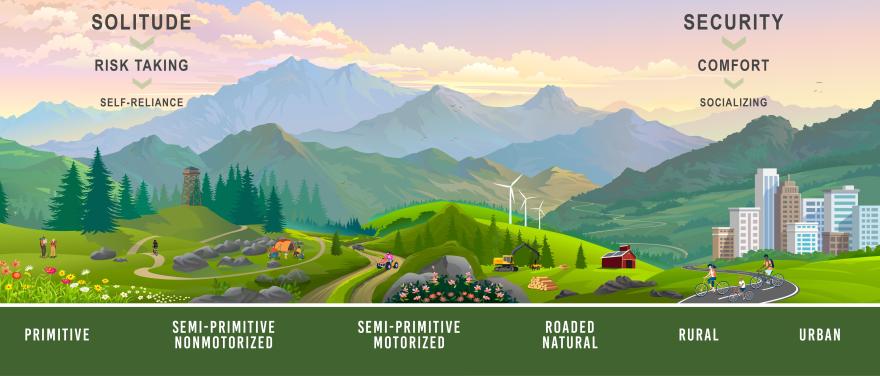
Desired conditions also recognize that different places can and should provide different experiences. A busy viewpoint, such as the gondola up Sulphur Mountain in Banff National Park, may be an appropriate place for concentrated use, while important habitat, such as the Silvertip Wildlife Corridor, may require significantly less disturbance.
Appropriate Visitor Activities, Facilities, and Services
Looking beyond desired conditions, land managers and planners can then select the direction for the types of visitor activities, facilities, and services that complement the desired conditions. This helps determine what opportunities are viewed as appropriate and inappropriate within a given landscape. For example, in an area where the desired condition is to provide what is sometimes referred to as a ‘primitive’ experience (see illustration above), developed restrooms and campsites may not be present.
‘Appropriate’ activities within the landscape may seem subjective, but when utilizing proper public consultation processes alongside assessments of the current state and use of the landscape, land managers can create ample recreation opportunities within landscapes to support the desired conditions.
Select Indicators and Thresholds
Once the ‘desired conditions’ are established, managers or other planning personnel can then monitor indicators and thresholds to determine whether those conditions are being maintained. Indicators are specific, measurable variables used to track changes in resources and social conditions. Indicators may be the number of hiking groups encountered per hour along a backcountry group, the number of illegal campfire rings or the number of social trails. While thresholds are the minimum acceptable limit for an indicator, such as no more than five group encounters per hour, zero illegal fire rings, and no more than one unauthorized social path per campsite.
In Banff National Park, this may look like seeing only five other backpacking groups in Paradise Valley, but as many as 100 people at the Rockpile at a given time.
Applying Visitor Use Management to the Landscape
Visitor use management can provide the tools to respond to overcrowding and increased visitation. Visitors can be directed toward more resilient areas, infrastructure can concentrate use where appropriate, trails can be designed to withstand higher levels of use, and signage and public education can encourage lower-impact behaviour.
It’s important to note, however, that VUM is an iterative approach and not a ‘one size fits all’ solution.
Determining the correct VUM strategies takes time and, often, trials. Additionally, some visitor use management systems work better in certain locations than others. For instance, ticketed or timed-use entry, day use permits, or limiting personal vehicle access on roadways, as in the case of the Moraine Lake corridor. As more people seek to recreate outdoors, an increase in Visitor Use Management systems is likely; but when it comes to new developments, these principles can be applied from the start.
Carrying capacity and visitor use management concepts should be considered before tourism development or plans for growth are considered, not after a place becomes overcrowded or damaged beyond repair.
For example, when it comes to proposals like the Fortress Mountain All-Season Resort or the Silvertip Gondola, understanding the carrying capacity of their respective regions, as well as their desired conditions, can help answer an important question: Is this a place where additional tourism development and visitation can be accommodated without compromising ecological values or the visitor experience?
(In both of the above examples, of course, the answer is a decided no.)
This question cannot be answered by looking at an individual resort or an attraction on its own. Visitors move between parks, public lands, communities, and recreation sites, while wildlife move across many of the same boundaries. The cumulative effects of multiple developments, existing visitation and expanded tourism, as well as other uses like industry or resource extraction, must be considered at the landscape level.
A Path Forward
As Alberta pursues tourism growth, carrying capacity, desired conditions, and visitor use management must be part of the conservation — and planning process — from the outset. Growth should be directed toward landscapes that can support it, while places that cannot sustain additional pressure must remain protected.
The goal is not to keep people out of, or away from, Alberta’s beautiful, biodiverse natural lands and waters: It’s to ensure that tourism growth doesn’t overwhelm these beloved landscapes, the iconic wildlife which inhabit them, and the unique experiences that make Alberta worth visiting in the first place.
So, for better or worse, there can be too many people on the land — or, rather, on the wrong land.
More Blog Posts
Can there be too many people on the land?
Not every landscape can accommodate the same level of use — nor an ever-increasing level of use…
Tourism growth needs landscape-level planning
Alberta is working to rapidly grow its tourism sector, but one key piece is still missing.…
Our statement on ‘Getting Major Projects Built in Canada’
Canada must not weaken environmental safeguards, Indigenous rights protections, or public participation in the name of “efficiency.” …