
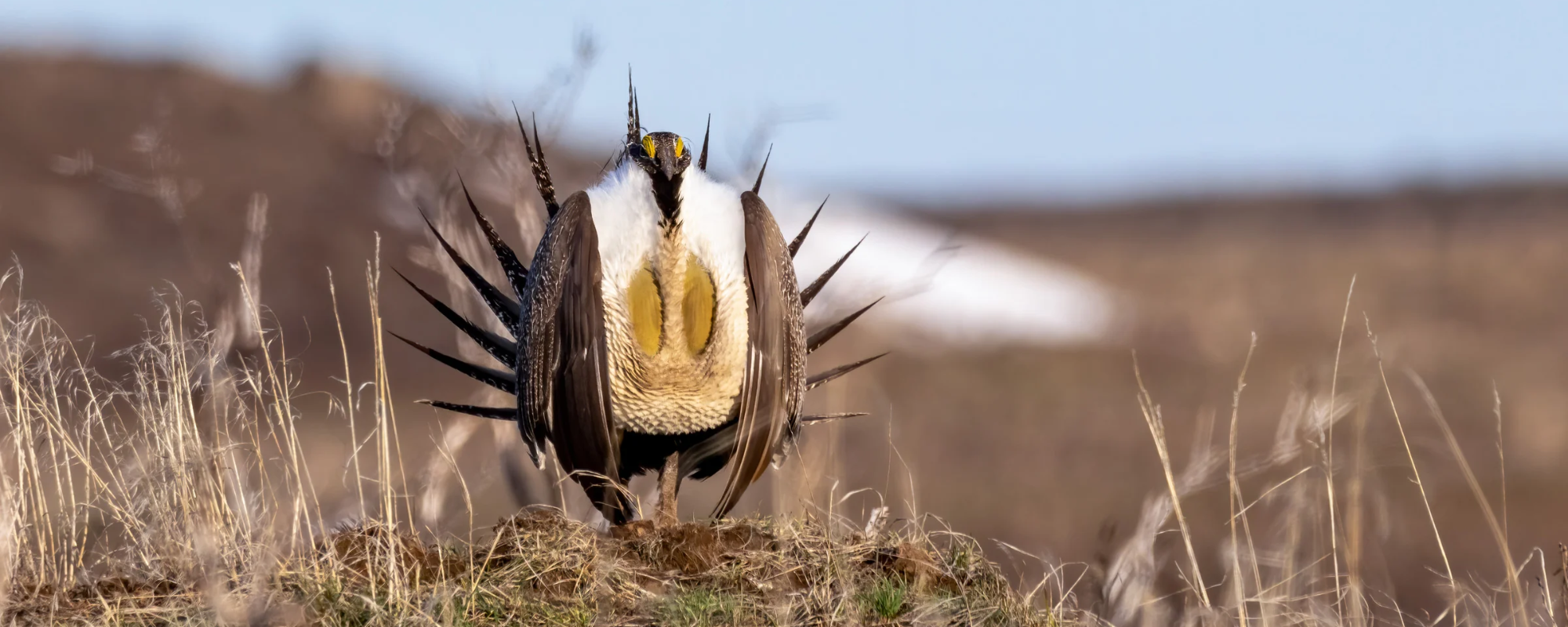
Lament for Sage Grouse — Memory, Tragedy, and Lessons
Lorne Fitch
November 16, 2026
Have you ever noticed that a full bag of potato chips evokes a sense of plenty with an attendant urge to indulge without restraint? As the bag empties a greater sense of conservation—meting out or sharing the remainder—barely registers, in recognition of the declining supply. And then, the bottom of the bag is reached, shock takes hold that everything is gone and nothing was saved.
Of course, we can always buy another bag of snacks, but what happens when our profligate and blind use of something leads to the loss of habitat, ecological integrity, or the loss of a species? You can’t go to the store for those essentials.
We are so intent in getting our rewards, the economic ones, that we pay scant attention to anything else. In fact, the “everything else” is treated as an externality, not worthy of consideration. The decline, to almost extirpation, of the Greater sage-grouse from the grasslands of southeastern Alberta is a cautionary tale of the phenomena. Their future was blindly, recklessly eaten, much like a bag of chips.
We rarely know where we started with population benchmarks, the monitoring of change is ineffectual, trends are ignored, and when an ultimate crash happens we reel with surprise—how could this have happened? This is the time-tested response of resource exploitation, of Atlantic cod, bison, beaver, and a host of others.
I suppose the Greater sage-grouse were doomed with the first plowed furrow in the grasslands of what would become Alberta. It took a little over a century for events to play out, aggravated by fifty-some years of recent petroleum development. And play out they did! The pleasure of remembering has been taken away from us because no longer are all the essential grassland species present to prompt our memory. But there are the occasional reminders.
Gaylen Armstrong was a provincial wildlife biologist, with responsibilities for southern Alberta in the 1960s. Now in his eighties he still displays the energy and curiosity of his earlier biological career. Gaylen’s work on sage-grouse population and habitat inventories, in the late 1960s was both formative and foundational. He reminded me we can sometimes forget what a short tenure we have in the task of accumulating biological information in Alberta. It’s also perplexing how quickly we forget what we knew.
A few pages of a biological report from 1968 allow us to see clearly where we were and allow us to reflect on where we have landed, after an exuberant period of petroleum development, cultivation and rural development.
The report, 1968 Sage Grouse (Centrocercus urophasianus) Investigations in Southern Alberta, is a rare snapshot of a benchmark in time and speaks volumes about how those benchmarks can shift, in real, and a very short time. A caveat in the report is that only forty per cent of what was then considered sage-grouse habitat was surveyed. As a result, numbers of dancing grounds (leks) and population estimates were likely conservative. Also, in context, the area surveyed was probably close to the last of the best, since much of the former range of sage- grouse would have been plowed up after the turning of the 20th century.
In 1968 23 dancing grounds were monitored, 613 males were counted and an estimated fall population for Alberta was 6240 birds. The latest data (2024) is eighteen males on three dancing grounds, for an estimated population around sixty birds. Some of these birds might have been releases from Montana stock. The population decline is statistically close to one hundred per cent.
Other indications of where we came from with sage-grouse include surveys from CPR staff and observations from a Canadian Wildlife Service biologist, both in 1968. Harold Janecke, a CPR employee and a Lethbridge conservationist, regularly monitored sage-grouse on rail runs between Manyberries and the Saskatchewan border. Sage-grouse were routinely observed next to the right of way and broods were often counted. For sage-grouse to be so numerous that they could be tallied by a train crew speaks to the robustness of the population in the late 1960s.
Ron Jakimchuk, a CWS biologist, provided observations on sage-grouse in 1968 in an article in Western Fish and Game magazine. He was on a combination antelope and sage-grouse hunt with colleagues and they encountered flocks of birds just south of Manyberries, likely in the present oil field. They flushed between 300 and 400 birds in a short walk on the sage flats of Manyberries Creek. It would be a long walk today to flush one grouse.
The tragedy of sage-grouse is, we knew early, much about the population and its habitat. Instead of reflecting on how to maintain populations, especially in the face of rapid petroleum development, the choice was to ignore the information, forge ahead—adding one well, one pipeline, one road, one powerline at a time—until we filled the landscape with an industrial footprint. There was little or no room left for sage-grouse—we ate most of their habitat through direct loss, fragmentation, and disruptive activity.
What was learned, if the lesson registers anywhere except in the conservation community and with biologists, is once something is lost, or nearly so, bringing it back to some semblance of population viability is exceptionally difficult, and fraught with complications. Like the metaphor of Humpty Dumpty, gluing things back together, once most of the pieces are broken is a herculean, heartbreaking task.
Be that as it may, habitat restoration and population recovery actions are underway. This is a testament to the tenacity, resourcefulness, and commitment of those involved in conservation efforts. Many of the industrial activities that precipitated the crash in sage-grouse populations have ground to a halt, providing an air of optimism for recovery. If peregrine falcons, whooping cranes, and swift foxes can be brought back, so can sage-grouse.
As we watch other resource gold rushes develop in the grasslands, like wind and solar power, exploration for rare earths, more agricultural conversion (both dryland and irrigation), and expanded transportation routes (to name a few), will we heed the lessons of the past? Sage-grouse might have an opinion on this question, if you can find any to ask.
The few that are left are wondering at the recent decision on the part of the government of Alberta who recently removed habitat protections on about 74 percent of their habitat. There was no public consultation or announcement of these drastic changes.
There is always a new eldorado to chase and this is now focused on helium extraction. One project has already been approved by the Alberta Energy Regulator in sage-grouse habitat. All of the previous habitat protection conditions have been removed, including protective buffers for leks, maintenance of sage brush communities, noise restrictions, no new, or upgraded roads, and timing constraints for any industrial activity. This is retrogressive.
No doubt helium is important. It has multiple industrial uses including applications for super conductors and quantum computing. When breathed in it produces comedic changes in the human voice. But sage-grouse aren’t laughing. As a gas it is lighter than air, but its extraction is heavier than sage-grouse can tolerate. This is déjà vu, all over again.
What is the point of a recovery strategy if the fundamental, foundational protections for a species are removed with the stroke of a politician’s pen? Two decades of conservation interventions have included five translocations from Montana populations, a captive breeding and release program, well-site reclamation and vegetation restoration at hundreds of wellsites, predator control, and the establishment of many conservation easements on private grasslands.
Population recovery takes time, time the government of Alberta and industrial interests are unwilling to provide. Taking away the essential protective tools for recovery puts all of the efforts to date at risk of failure, and further increases the spectre of extirpation for an iconic grassland species.
One might have hoped that the virtual loss of sage-grouse would have taught us about the worth of such things and a commitment not to repeat this carelessness. Apparently not. To let the remnants of the population slip away with increased industrial activity is unconscionable. This is a pivotal point for sage-grouse. Either we commit to stewardship and allow them to recover, or we resign ourselves to another wild species disappearing because of greed.
Lorne Fitch is a Professional Biologist, a retired Fish and Wildlife Biologist and a former Adjunct Professor with the University of Calgary. He is the author of Streams of Consequence and Travels Up the Creek: A Biologist’s Search For a Paddle.
More Blog Posts
Lament for Sage Grouse — Memory, Tragedy, and Lessons
Either we commit to stewardship and allow them to recover, or we resign ourselves to another wild species disappearing because…
No to Silvertip Gondola: Protect Alberta’s Parks and the Bow Valley
The proposed Silvertip Gondola is now under provincial review. Albertans have until November 26, 2026, to tell the Government of…
Alberta’s Red Tape Reduction Conservation Initiative
What does “red tape reduction” really mean for conservation in Alberta? Here’s what the province has been up to recently.…